
It won't take long after you start attending church to hear the word "fellowship" often. You will hear it in sermons, and in the names of Sunday school classes. People invite you to "fellowship events" and talk about the "fellowship of believers" like you already know what they mean.
But if you are honest, the word might still feel a little vague. Is fellowship just a churchy word for hanging out? Is it about potlucks and coffee hour? Is it something deeper than that, and if so, what does it look like in real life?
These are good questions, and they deserve a straight answer. Because fellowship is one of those words that Christians use so often it has almost lost its meaning, which is a shame, because what it describes is central to what it means to be a Christian.
Why Fellowship Matters More Than You Think
Let's start with what the Bible actually says. The Greek word translated as fellowship in the New Testament is koinonia (koy-noh-NEE-ah). It means sharing, participation, and partnership. It is not a casual word. It carries the idea of people who hold something in common at a deep level, not just interests or schedules, but life itself.
Acts 2:42 describes the early church this way:
"And they continued steadfastly in the apostles' doctrine and fellowship, in the breaking of bread, and in prayers."Acts 2:42 (NKJV)
Fellowship is listed alongside teaching, communion, and prayer as one of the core practices of the church. It is not optional. It is not the social part that happens before the real stuff. Fellowship is itself one of the real things.
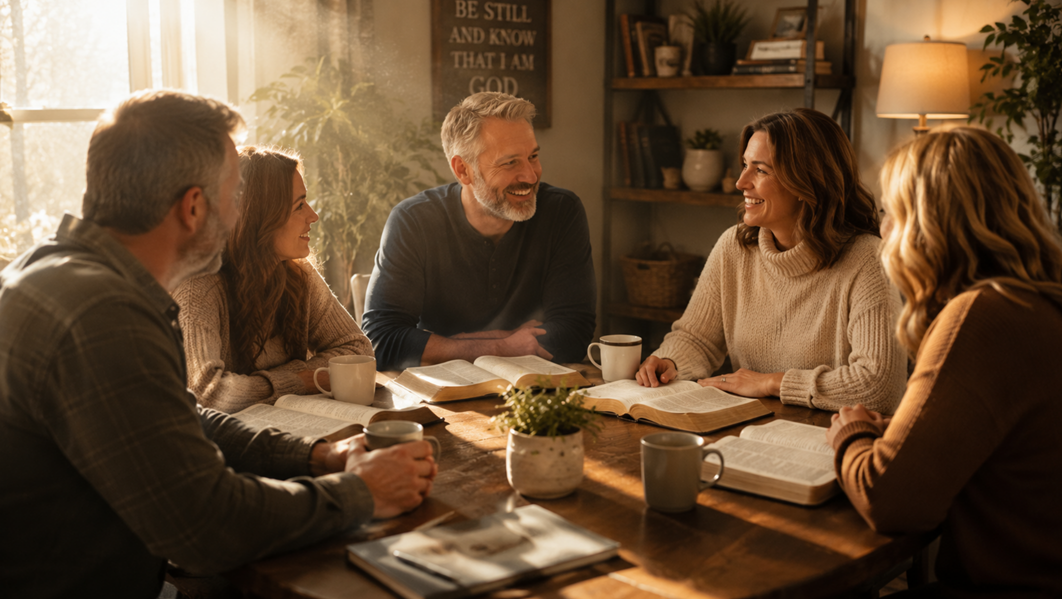
The early believers did not just attend the same gatherings. They shared their lives, meeting in each other's homes, eating together, knowing each other's circumstances, and responding to real needs. When someone struggled, the community knew about it and showed up.
That is the picture Scripture gives us. Not a group of individuals who happen to attend the same building on Sunday mornings, but a community of people connected to one another around a shared faith and a shared life.
It Is More Than Showing Up
A common misunderstanding new believers have about fellowship is thinking that attending church is the same as having it; they are not the same.
You can sit in a church service every week for years and still be completely unknown. You can shake hands during the greeting time, smile at the same people, and walk out without anyone knowing your name or your story. That is attendance, and attendance is not fellowship.
Fellowship requires something more. It requires being known, not just recognized, and it requires letting people share life with you.
That is harder than it sounds, especially if you are new to faith or new to a particular church. The established relationships around you can feel intimidating. It can seem like everyone already has their people, their small group, their history together, and there is no obvious way in.
But those relationships started somewhere. Every person who now belongs in a church community was once new to it. The difference between the people who found their place and the ones who never quite did is usually not personality or luck. It is whether or not they took the small, sometimes uncomfortable step of moving toward others rather than waiting for others to move toward them.
What Fellowship Actually Looks Like
Fellowship looks different in different church contexts, but it tends to happen in smaller settings rather than large ones. A Sunday morning service with hundreds of people is a wonderful thing, but it is not the primary place where genuine community is built. That happens in smaller groups, in homes, in conversations over a meal, in the kinds of settings where there is space to know and be known.
If your church has a small group ministry, that is the most direct path toward fellowship. Small groups give you a consistent set of people to be with, a context for sharing honestly, and accountability that a large gathering cannot provide.
If small groups are not available or accessible, look for other ways in. Volunteer for something that puts you next to the same people each week. Arrive early and stay late. Accept invitations even when you would rather go home, and ask someone to have coffee. The path into community is almost always through small, repeated choices to show up and engage, not through a single dramatic moment of connection.
Fellowship also means being willing to receive from others, not just give. For some people, accepting help, admitting struggle, or being honest about what is hard feels more vulnerable than anything else. But a community that only knows your Sunday morning best is not really a community at all. True fellowship involves being seen in the harder moments too.
What It Does for Your Faith
Here is what I have seen in eighteen years of walking with new believers:
The ones who find genuine community almost always grow.
And the ones who try to do faith entirely on their own
almost always struggle more than they need to.
That is not a coincidence. We were not designed for isolation. Faith is not meant to be practiced alone. The early church understood this, which is why they devoted themselves to fellowship the same way they devoted themselves to prayer and Scripture.
When you are in genuine community with other believers, you have people who will pray with you and for you. You have people who will notice when you are struggling and ask about it. Some of them have walked through hard seasons themselves and can tell you from experience that God was faithful even when it didn't feel like it. And they will challenge you when you are off track and celebrate with you when things go well. None of that is possible when you are sitting alone in a pew week after week, surrounded by people you don't really know.
The Fears That Keep New Believers on the Sidelines
If the idea of genuine fellowship sounds wonderful and terrifying at the same time, you are in good company. Most new believers carry a few quiet fears into the church lobby, and naming them helps take away their power.
There is the fear of not knowing enough. You worry someone will reference a book of the Bible you cannot find or use a term you have never heard. Here is the truth: nobody who matters is keeping score. Every person in that room was new once, and the healthiest believers light up when they get to walk alongside someone just starting out. Your questions are not a burden. They are often a gift that reminds longtime Christians why any of this matters.
Then there is the fear of being judged for your past or your present. But a church full of people who understand grace is a church full of people who know they needed it themselves. You are not the only one in the room with a story.
And there is the simple fear of awkwardness. The first few conversations with strangers are awkward for almost everyone, introvert or not. Awkward is not a sign you are in the wrong place; it is a sign you are somewhere new. Give it a little time, because real fellowship is built through repeated small moments, not one perfect first impression.
If any of those fears has been holding you back, you do not need to conquer it before you show up. You just need to show up carrying it. Courage in fellowship rarely looks dramatic. It usually looks like walking through the door a second time.
What to Do If You Haven't Found It Yet
Maybe this kind of community sounds good but feels far from your experience so far. That is true for more believers than you would guess. Finding genuine fellowship takes time and it takes initiative; it does not usually just happen to you.
Here are a few practical starting points. Ask your pastor or a church leader what the best on-ramp to community is in your specific church; most churches have thought about this and have a clear answer. Then take that next step, even if it feels awkward. Awkward is normal, and it does not mean you are doing the wrong thing.
After that, be patient with the process. Community is built over months and years, not weeks. The depth of connection you are looking for will not appear immediately, but it will grow if you keep showing up.
And in the meantime, remember that you are already part of the larger fellowship of believers who have walked this road before you. That community stretches across centuries and across the world. You are not as alone in this as you might sometimes feel.
For anyone still finding their footing in church life, my free guide Ten Questions New Believers Are Afraid to Ask offers honest answers to the questions most people are too afraid to ask out loud.