
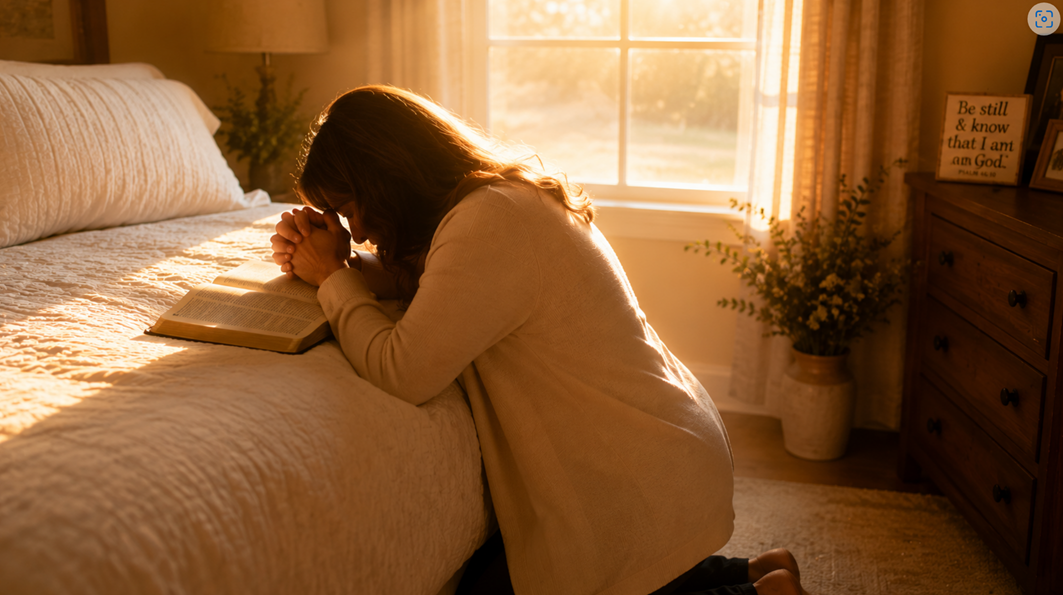
One of the questions new believers are often afraid to ask out loud is this one: what happens when I sin after becoming a Christian?
It feels like a dangerous question. Like asking it is somehow admitting that you are planning to sin, or that you are not taking your faith seriously enough. It is one of the most important questions you can ask, because the answer shapes everything about how you relate to God when you inevitably fall short.
And you will fall short. Not because your faith is weak or your commitment is insufficient, but because you are human, and becoming a Christian does not remove your capacity to sin. What it does is change your relationship to sin, your awareness of it, your desire to be free from it, and what happens when you are honest with God about it.
First, Understand What Has Not Changed
When you became a Christian, something permanent happened. You were forgiven. Not just your past sins, but all of them.
"There is therefore now no condemnation to those
who are in Christ Jesus, who do not walk according to
the flesh, but according to the Spirit."Romans 8:1 (NKJV)
That is a present-tense statement. It does not say there was no condemnation, past tense, before you sinned again. It says there is no condemnation now, for those who are in Christ.
Your standing before God is not based on your performance. It is based on what Jesus did. When God looks at you, He sees you clothed in the righteousness of His Son. That does not change when you sin. Your relationship with God is secure in a way that your behavior cannot undo.
This is what theologians call justification, and it is the foundation of everything else. You are not on a probationary period where a certain number of sins will get you kicked out. You are a child of God, and that status is permanent.
This is one of the truths I return to most often in my own life, because the temptation to believe that my standing with God fluctuates based on my behavior is strong. On good days, I feel close to Him. On bad days, I feel like I have lost ground. The truth is that my standing was never based on my performance. It was always based on what Jesus did. And what Jesus did is finished. That does not make sin irrelevant, but it does mean that sin cannot reverse what God has already declared to be true about you.
But Sin Still Has Consequences
Understanding that your standing before God is secure does not mean sin is harmless or that it does not matter.
Sin still damages your relationship with God in the sense that it disrupts fellowship. It does not sever the relationship, but it strains it. Think of it like a child who disobeys a parent. The child is still the parent's child. Nothing about that has changed. The disobedience creates distance, a tension in the relationship, that is resolved through honesty and repentance.
Sin also has real consequences in your life and in the lives of people around you. Choices have outcomes. The grace of God forgives the sin, yet it does not always remove the natural consequences of it. That is not punishment. It is simply how a moral universe works.
And sin, particularly unaddressed sin, has a way of hardening the heart over time. The longer you go without bringing something before God, the easier it becomes to rationalize it, minimize it, and eventually stop seeing it as sin at all. That is a dangerous trajectory, and it is why honesty with God matters consistently, not just at the moment of conversion.
What Repentance Actually Looks Like
Repentance is one of those words that sounds more complicated than it is. It means turning around. Acknowledging that you went in the wrong direction and choosing to go the right direction instead.
It is not the same as feeling bad about something. You can feel bad about a sin for entirely self-centered reasons, because you got caught, because of the consequences, because it damaged your reputation. That is not repentance. Repentance is about recognizing that what you did was wrong in relation to God and to others, and wanting to move away from it.
First John 1:9 gives one of the clearest pictures of what to do when you sin: "If we confess our sins, He is faithful and just to forgive us our sins and to cleanse us from all unrighteousness" (NKJV). Confess. He forgives. He cleanses. That is the cycle, and it is meant to be ongoing throughout the Christian life, not just a one-time event at conversion.
Confession does not have to be elaborate. It does not require a specific formula. It is being honest with God about what happened, agreeing with Him that it was wrong, and receiving the forgiveness He has already made available through Jesus.
What makes confession powerful is not the words you use. It is the honesty behind them. God is not waiting for a perfectly worded apology. He is waiting for a real one. And the moment you bring something into the light, it loses the power it had in the dark. That is the most practical thing I have learned in my own walk with God: hidden sin grows heavier with every day you carry it, and confessed sin loses its weight almost immediately. Not because the consequences disappear, but because the isolation does.
What About Repeated Sin
Here is where many new believers get stuck: what do you do when you keep sinning in the same area, when you confess the same thing over and over and wonder if anything is changing?
First, understand that the cycle of confession and forgiveness is not a sign of failure. It is a sign that you are engaged. The alternative, pretending the sin is not there or giving up on dealing with it at all, is far more dangerous.
Second, understand that sanctification, the process of becoming more like Jesus, is slow. It happens over a lifetime, not overnight. You will not wake up one day and find that all your struggles have disappeared. You will find, staying close to God and bringing your honest heart to Him, that the struggles gradually shift. Things that used to pull you strongly begin to lose their grip. New areas of growth open up. The trajectory is forward even when individual moments feel like regression.
Third, a particular sin that has a consistent hold on you may mean you need help beyond personal confession. A pastor, a trusted mentor, or a Christian counselor can walk with you through patterns that are hard to break alone. There is no shame in that. Scripture describes the Christian life as something done in community, not in isolation.
I have walked through seasons of repeated failure in my own life, and the lesson that took the longest to learn was that God's patience with me was not running out. Every time I came back, He was there. Not disappointed in the way I feared, but ready to restore.
That pattern of return, not the failures themselves,
is what shaped my faith into something real.
You Are Not Disqualified
Whatever you have done since becoming a Christian, you are not disqualified. You have not used up God's forgiveness. You have not wandered beyond His reach.
Peter denied Jesus three times on the night of the crucifixion. Jesus reinstated him personally and entrusted him with leading the early church. David committed adultery and arranged the murder of the woman's husband. He is still described in Scripture as a man after God's own heart. Paul described himself as the chief of sinners.
None of that is permission to sin carelessly. It is evidence that God's grace is larger than your worst moments. Keep coming back. Keep being honest. Keep trusting that the One who began a good work in you will carry it on to completion.
The Christian life is not about never falling. It is about what you do when you fall. And the answer, every single time, is the same: turn around, come back, and let Him meet you where you are. He is not standing at a distance with His arms crossed. He is standing with His arms open. That is the God you belong to, and His patience with your process is far greater than you imagine.
Grace does not run out, no matter how many times you have to come back to it. I wrote The Way Through for the messy, honest, real-life part of following Jesus, and my free guide Ten Questions New Believers Are Afraid to Ask takes on the questions people are often too nervous to say out loud. You are not disqualified, and you are not alone.